Or keep it on your phone instead
For each building the council runs, The Venue Record drafts the four procedures from your answers and keeps a record of who has read them.
No card needed to start. Then from £19 a month per building. How the reminders work.
What’s in it
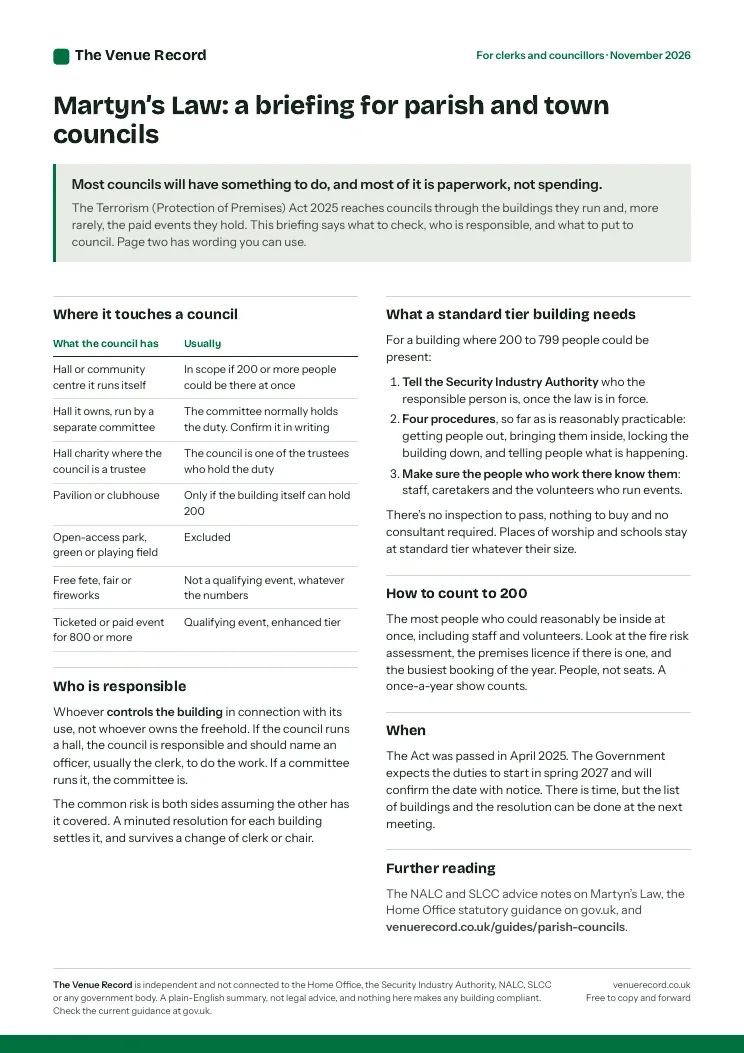
Page one, the briefing. Where the Terrorism (Protection of Premises) Act 2025 touches a council: halls it runs, halls it owns, hall charities where the council is a trustee, pavilions, open spaces and events. Who is responsible, what a standard tier building needs, how to count to 200, and when the duties are expected to start.
Page two, wording you can use.
- An agenda item for the next meeting
- A draft resolution naming the responsible person for each building
- A risk register entry: risk, consequence, control, owner and review
- The clerk’s list: each building and event, who controls it, the most people at once, where the figure came from, and the next step
How councils use it
Circulate page one with the agenda so councillors arrive knowing the basics. Bring the filled-in list to the meeting, agree which buildings are in scope, and pass the resolution. Add the risk register entry and review it with the insurance renewal each year.
Where a separate committee runs a hall the council owns, send them page one too. Both sides confirming who holds the duty, in writing, is the most useful single thing to come out of the meeting.
The full detail is in the guide to Martyn’s Law for parish and town councils. 291 hall charities on the Charity Commission register have a council as a trustee: more figures on village halls.
Questions
Does Martyn's Law apply to parish councils?
Where a council controls a building that 200 or more people could be in at once, or runs a ticketed or paid event for 800 or more, yes. Open-access parks, playing fields and recreation grounds are excluded.
Can we use the wording in our own papers?
Yes. Copy it into your agenda, minutes and risk register, change it to suit, and forward the briefing to anyone. Replace the bracketed parts with your own buildings and dates.
Not legal advice. Your fire risk assessment, your licence and your insurer set what your building needs.
After the meeting
Once the council knows which buildings are in scope, The Venue Record keeps each one’s procedures, who has read them, the routine checks and the certificates in one place, so the clerk can report to council from a single record. How it works for councils.