Or keep it on your phone instead
Every one of these checks sent to whoever does it, and recorded from their phone. Nothing to print, nothing to lose.
No card needed to start. Then from £19 a month per building. How the reminders work.
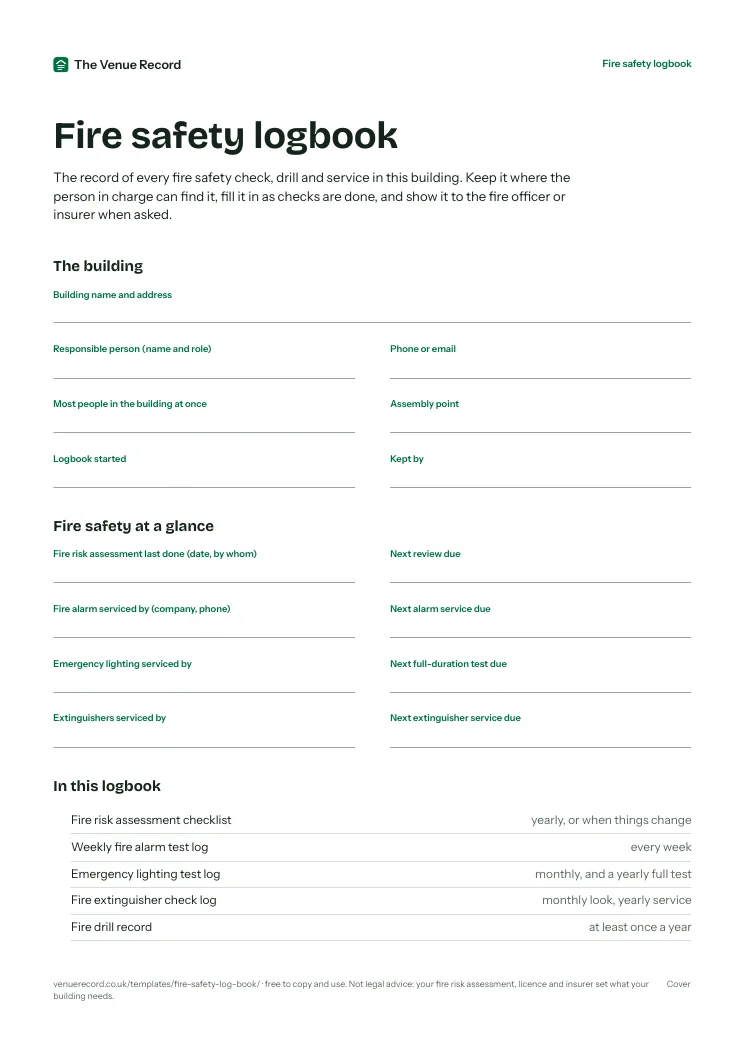
What’s in it
A cover sheet for the building’s details and who services what, then the five sheets most small premises need:
- Fire risk assessment checklist: the yearly walk-round, in the government guide’s five steps
- Weekly fire alarm test log: 52 weeks, a different call point each time
- Emergency lighting test log: twelve monthly tests and the yearly full-duration test
- Fire extinguisher check log: a tick a month for each one, and the yearly service
- Fire drill record: one sheet per drill, signed by a second person
Print one set a year. Keep it with the fire risk assessment, somewhere the person in charge can find it without phoning anyone.
Why a logbook
The law that covers fire safety in most non-domestic buildings, the Regulatory Reform (Fire Safety) Order 2005, says fire equipment must be maintained and kept working. It doesn’t say how to prove it. The logbook is how. When a fire officer visits, or an insurer asks after a claim, it’s the first thing they want to see.
Gaps do more damage than faults. A fault written down with what was done about it shows a building being looked after. A blank month looks like nobody checked.
How to keep it going
- Fill in the cover first: who services the alarm, the lights and the extinguishers, and when each is next due.
- Record the date a check was actually done, not the day it was meant to be.
- Have a second person look through it every few months. Whoever does the checks shouldn’t be the only one who ever reads them.
- Keep last year’s sheets. Most insurers expect several years of records to be available.
Keep a fire safety training record alongside it, for who has been shown what to do in a fire.
For how often each check is usually done, and who should do it, see fire safety test frequencies.
Questions
Is a fire safety log book a legal requirement?
The Fire Safety Order requires fire equipment to be maintained and kept in working order, and fire risk assessments usually ask for a record of the checks. It doesn't name a logbook, but a logbook is the usual way to show the checks were done.
What should a fire safety log book contain?
The building's details and who services each system, then a record of the weekly alarm tests, monthly emergency lighting and extinguisher checks, the yearly services, fire drills, and any faults with what was done about them.
How long should fire safety records be kept?
There is no fixed period in law. Keeping several years is common practice, and your insurer or fire risk assessor may ask for a specific period.
Not legal advice. Your fire risk assessment, your licence and your insurer set what your building needs.
Rather not keep it on paper?
The Venue Record sends each check to whoever does it, by email, and they record it from their phone with no account. A second person can approve it, and the whole record is there to hand over when someone asks. How the reminders work.