Or keep it on your phone instead
Whoever flushes the taps gets a weekly reminder and records it from their phone, with the monthly temperatures alongside.
Starts a 14-day trial, no card needed. Then from £19 a month per building. How the reminders work.
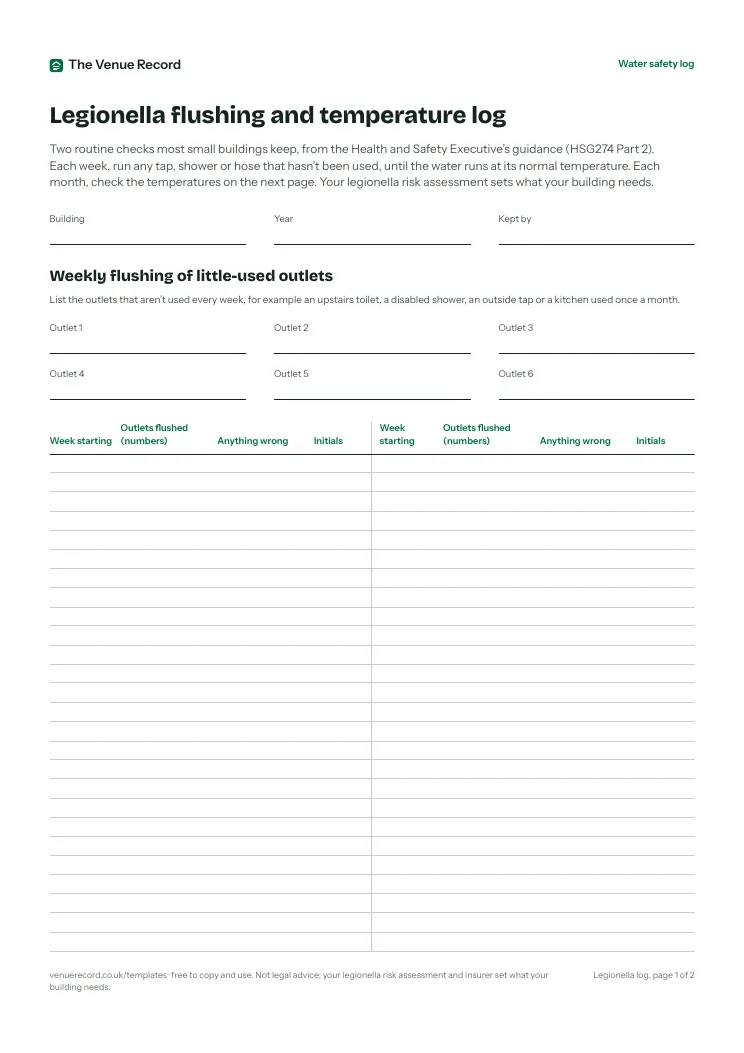
What it records
- Weekly flushing: the taps, showers and hoses that aren’t used every week, and a line a week to show each was run through
- Monthly temperatures: the hot and cold taps nearest to and furthest from the water heater, and the stored hot water where you can check it
- Every three months: showerheads and hoses cleaned and descaled
- Any reading outside the range, and what was done about it
The temperatures to look for
From the Health and Safety Executive’s technical guidance on hot and cold water systems (HSG274 Part 2):
- Hot water at the tap: at least 50°C within one minute of running
- Cold water at the tap: below 20°C within two minutes
- Stored hot water, in a cylinder or calorifier: at least 60°C
A tap fed through a mixing valve, often fitted where children or vulnerable people use the building, runs cooler on purpose. Write “mixed” for it rather than a failure.
Why little-used taps matter
Legionella bacteria grow in water that sits still at lukewarm temperatures. In a hall or church that is used a few times a week, the upstairs toilet, the accessible shower or the second kitchen can go weeks without running. Flushing them weekly, until the water runs at its normal temperature, is one of the simplest controls, and the one most often missed.
The log sits alongside your legionella risk assessment, which says which outlets to include. More in the guide to legionella in village halls and churches.
Questions
Do village halls need a legionella risk assessment?
Anyone responsible for a building with a water system must assess the risk from legionella and manage it. For most small halls the assessment is short, and the routine controls are the weekly flushing and monthly temperature checks on this log.
How long should you flush a little-used tap?
Until the water runs at its normal temperature: hot at its usual heat and cold properly cold. That is often a couple of minutes. Do it gently so it doesn't spray.
How long should legionella records be kept?
The Health and Safety Executive's code of practice says at least five years.
Not legal advice. Your fire risk assessment, your licence and your insurer set what your building needs.
Rather not keep it on paper?
The Venue Record sends each check to whoever does it, by email, and they record it from their phone with no account. A second person can approve it, and the whole record is there to hand over when someone asks. How the reminders work.