Rather do it on your phone? The fire door check lists your doors, lets you mark each one as you go, and prints the record.
Or keep it on your phone instead
Whoever checks the fire doors gets a reminder when they're due and records each door from their phone, faults and all.
Starts a 14-day trial, no card needed. Then from £19 a month per building. How the reminders work.
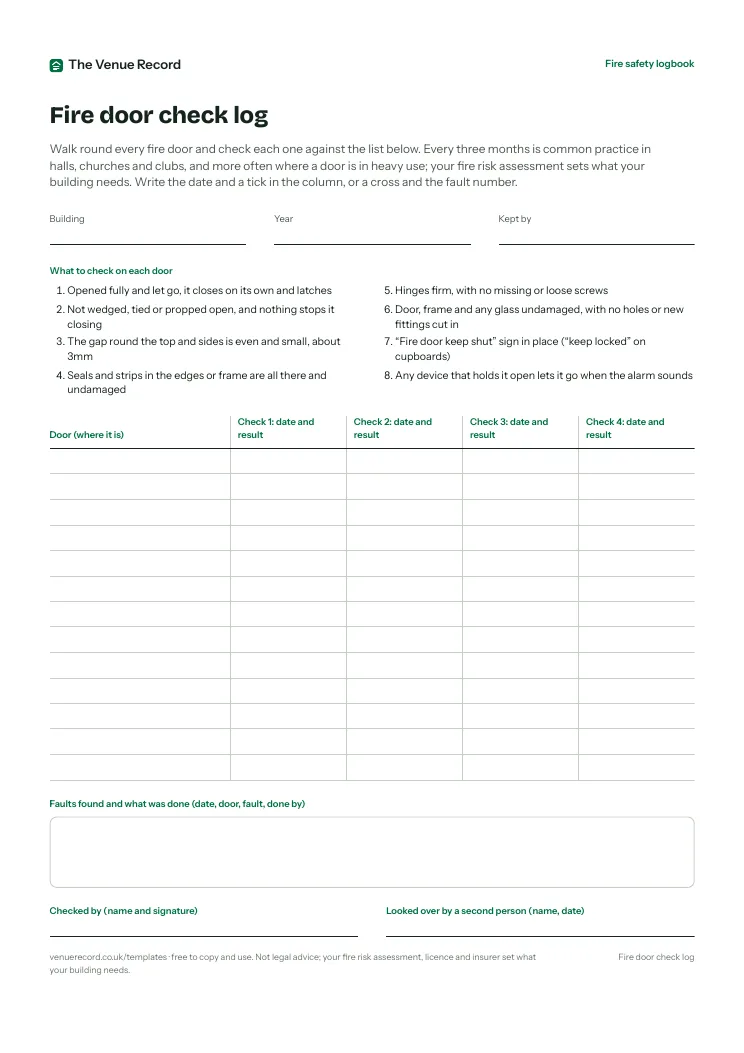
What to check on each door
- Opened fully and let go, it closes on its own and latches
- It isn’t wedged, tied or propped open, and nothing stops it closing
- The gap round the top and sides is even and small, about 3mm
- The seals and strips in the edges or frame are all there and undamaged
- The hinges are firm, with no missing or loose screws
- The door, frame and any glass are undamaged, with no holes or new fittings cut in
- The “Fire door keep shut” sign is in place (“keep locked” on cupboards)
- Any device that holds it open lets it go when the alarm sounds
The sheet has these on it, so whoever does the round can work down the list at each door.
How often, and what to do with a fault
Every three months is common practice in halls, churches and clubs, and more often where a door is in heavy use, such as the one between the hall and the kitchen. Your fire risk assessment sets what your building needs.
The fault people find most is the simplest: a door that doesn’t close by itself, because the closer has weakened or something is in the way. Write the fault down with the date, then what was done and when. A fault fixed and recorded shows a building being looked after.
Some repairs, such as replacing seals, glass or the door itself, need a competent person, because a fire door only holds back fire as a whole set: door, frame, seals, hinges and closer together.
Questions
How often should fire doors be checked?
Every three months is common practice in public buildings such as halls and churches, and more often where a door gets heavy use. Your fire risk assessment sets what your building needs.
What gap should there be around a fire door?
Around 3mm at the top and sides is the usual figure, and it should be even. A bigger gap at the bottom can be normal, depending on the door; ask whoever did your fire risk assessment if you're unsure.
Can a fire door be propped open?
Not with a wedge or a hook. If a door needs to stand open, a device that holds it open and releases it when the alarm sounds can be fitted, where your fire risk assessment allows it.
Not legal advice. Your fire risk assessment, your licence and your insurer set what your building needs.
Rather not keep it on paper?
The Venue Record sends each check to whoever does it, by email, and they record it from their phone with no account. A second person can approve it, and the whole record is there to hand over when someone asks. How the reminders work.